
Nepali rashifal: find your rashi and read it well
For many Nepali families, the day starts with aajako rashifal: a few lines in the newspaper, on the radio or on a phone, for each of the twelve rashis. It is the most widely read part of Jyotish, and also the most misunderstood.
This guide, by Jyotish Prakash Basistha, explains what a rashifal is based on, how to find your own rashi (by your Kundali or by the first letter of your name), and how to read the daily rashifal so it helps rather than worries you.
What is a rashifal?
Rashifal means “the result for a rashi”. It is a short reading of how the planets moving through the sky today (their gochar, or transit) fall for each of the twelve rashis. The same twelve readings are given to everyone, so each one speaks to roughly one person in twelve.
That is both its use and its limit. A rashifal is a good daily reminder of the mood of the sky. It cannot know your Lagna, your dasha or the strengths in your own chart, which is why two people of the same rashi can have very different days.
Your rashi is your Moon sign, not your sun sign
When someone in Nepal asks “what is your rashi?”, they mean your Janma Rashi: the sign the Moon was in when you were born. Western horoscopes in English magazines use the sun sign instead, and they use the tropical zodiac. That is why your rashi and your “star sign” are often different, and why a Nepali rashifal and an English horoscope for “Aries” are not talking about the same people.
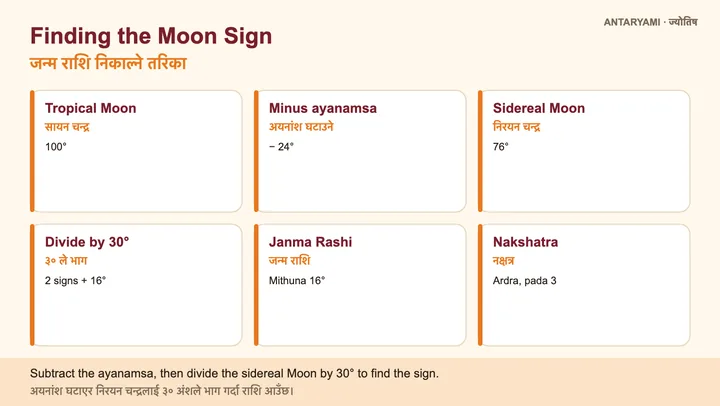
Jyotish puts the Moon first because the Moon is the mind (manas). It moves fast, changing sign about every two and a quarter days, so it is the planet that best describes how a day feels. In the short lesson below, Jyotish Prakash Basistha explains how the Janma Rashi is worked out.
How to find your rashi
There are two ways, and the first is always the more reliable.
- From your Kundali. Enter your date, time and place of birth and the chart shows the sign your Moon was in. Even if you are unsure of the birth time, the Moon sign is usually right, because the Moon stays in one sign for more than two days. Only if the Moon changed sign on the day you were born does the time decide it.
- From your name (namakshar). In Nepali tradition the name given at the naming ceremony (nwaran) starts with a syllable from the nakshatra pada the Moon was in at birth. So the first letter of that name points to your rashi. This works only for that traditional name, not for a name chosen for its sound.
Find your Moon sign in a free Kundali →How to read your birth chart →
The twelve rashis and their name letters
These are the traditional starting syllables (namakshar) for each rashi, with the Western sign that shares its name. Remember that the Western sign of the same name covers different dates: the match is in the name of the sign, not in your birthday. Tap a sign to open today’s rashifal for it.
- Mesha (Aries)चु, चे, चो, ला, ली, लू, ले, लो, अ
- Vrishabha (Taurus)इ, उ, ए, ओ, वा, वी, वू, वे, वो
- Mithuna (Gemini)का, की, कू, घ, ङ, छ, के, को, ह
- Karka (Cancer)ही, हू, हे, हो, डा, डी, डू, डे, डो
- Simha (Leo)मा, मी, मू, मे, मो, टा, टी, टू, टे
- Kanya (Virgo)टो, पा, पी, पू, ष, ण, ठ, पे, पो
- Tula (Libra)रा, री, रू, रे, रो, ता, ती, तू, ते
- Vrishchika (Scorpio)तो, ना, नी, नू, ने, नो, या, यी, यू
- Dhanu (Sagittarius)ये, यो, भा, भी, भू, धा, फा, ढा, भे
- Makara (Capricorn)भो, जा, जी, खी, खू, खे, खो, गा, गी
- Kumbha (Aquarius)गू, गे, गो, सा, सी, सू, से, सो, दा
- Meena (Pisces)दी, दू, थ, झ, ञ, दे, दो, चा, ची
How a daily rashifal is worked out
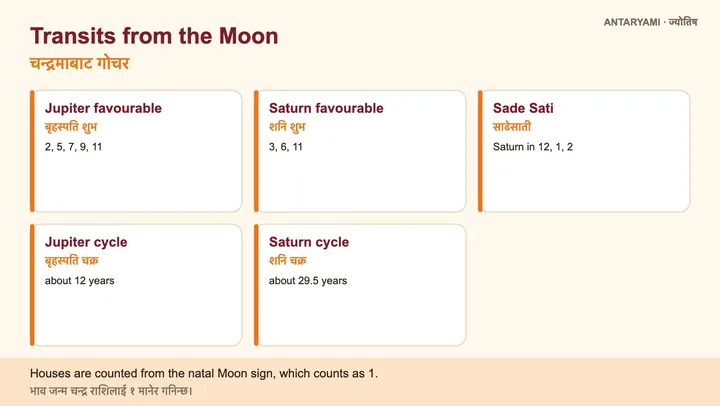
A Jyotishi starts from where the Moon is today, counted from your Janma Rashi. Classical texts give the Moon’s transit through the 1st, 3rd, 6th, 7th, 10th and 11th signs from your own Moon as broadly supportive, and the others as calls for more care. Onto that come the slower planets: where Guru (Jupiter), Shani (Saturn), Rahu and Ketu sit from your rashi colours weeks, months and years, not just a day.
This is also where Sade Sati comes from: the seven and a half years when Shani moves through the sign before your Moon, your Moon sign itself, and the sign after it. A rashifal can tell you that your rashi is in Sade Sati; only your full chart can tell you how heavy it will be for you.
Antaryami’s daily rashifal follows this method. It is prepared with AI from your Moon sign and the day’s planetary positions, following the rules of Brihat Parashara Hora Shastra, and is published in Nepali and English for today and tomorrow.
How to read your rashifal well
Read it as weather, not as a verdict. A forecast of rain does not stop you going out; it tells you to take an umbrella. A few habits help:
- Read your Moon sign, and if you know it, your Lagna too. Many Jyotishis read both.
- Take the gist, not every line. One “difficult day” for one in twelve people is a nudge to be patient, not a reason to cancel your life.
- Look for patterns over a week, not a single day. The slower planets show up as a theme.
- For a big decision (marriage, a move, property), do not rely on a rashifal. That is what a Kundali reading and a muhurta are for.
- If a rashifal frightens you, stop and talk to someone. Jyotish is meant to bring clarity and calm, not fear.
Beyond the rashifal: your own chart
A rashifal answers “what is the sky doing for my sign?”. Your Kundali answers “what is the sky doing for me?”. The difference is the dasha: the planetary period you are running now, which decides which transits matter most for you. Someone in a strong Guru dasha may barely feel a hard Shani transit; someone in a Shani dasha may feel it much more.
You can see your running dasha in your free Kundali, ask Antaryami AI what a transit means for your chart, or talk to a Jyotishi who will read the two together.
See your running dasha →Ask Antaryami AI →Talk to a Jyotishi →
Why follow the sky together, in a community
Reading a rashifal alone is a one-way conversation: a few lines arrive, and you are left to guess what they mean for you. In a community the conversation goes both ways. When Shani changes sign or Guru turns retrograde, you hear what it means, ask how it touches your own rashi, and see how others are living through the same transit.
That is what the Antaryami Official community is for. Jyotish Prakash Basistha posts upcoming transits ahead of time, runs monthly questions and answers, and teaches the Introduction to Jyotish course there, the course the video above comes from. It is in Nepali and English, and free to join.
A hard transit is easier with a steady mind. Many members pair Jyotish with a short daily meditation; if you are new to it, Meditation for Beginners starts from zero, and the Soham guided meditations on YouTube are free.
Join the Antaryami Official community ↗Introduction to Jyotish course ↗Prakash Bhattarai Community (free) ↗Meditation for Beginners community ↗meditationforbeginners.com ↗Soham guided meditations on YouTube ↗
Your daily rashifal, free
Antaryami publishes the rashifal for all twelve rashis every day, in Nepali and English, with today and tomorrow side by side and the name letters for each sign. It is free on the website and in the Antaryami app on Android, with iPhone in public beta.
Read today’s rashifal →Nepali patro →Get the Antaryami app →Follow on Facebook ↗
Questions people ask
Should I read my Moon sign or my sun sign?
For a Nepali rashifal, your Moon sign (Janma Rashi). That is the sign Nepali and Indian rashifals are written for. Western horoscopes use the tropical sun sign, which is a different system.
Can I find my rashi without knowing my birth time?
Usually, yes. The Moon stays in a sign for about two and a quarter days, so your date and place of birth are normally enough. Only if the Moon changed sign on your birthday does the time matter.
Is rashifal by name accurate?
Only if your name was given by the namakshar tradition at your naming ceremony. Then its first syllable comes from your birth nakshatra and points to your rashi. For other names, use your Kundali.
Why do different rashifals say different things?
Each writer weighs the transits a little differently, and some use the Lagna, some the Moon sign. A rashifal is a general reading for one in twelve people, so treat it as a guide to the day’s mood rather than a precise prediction.
How often does the rashifal change?
Every day. The Moon moves about 13 degrees a day and changes sign roughly every two and a quarter days, so the reading for each rashi shifts daily, while the slower planets set the longer themes.
Is the Antaryami rashifal written by a person or by AI?
It is prepared with AI from your Moon sign and the day’s planetary positions, following the classical rules of Brihat Parashara Hora Shastra. For a reading of your own chart, talk to a Jyotishi.