Vedic vs Western astrology: why your sign changes
Many people meet Jyotish after years of reading Western horoscopes, cast a Vedic chart, and find that they are suddenly a different sign. It is unsettling, and the usual explanation online is either too vague or too technical.
This guide, by Jyotish Prakash Basistha, explains in plain words why Vedic (Jyotish) and Western astrology give different signs, how to find your Vedic sign, and what else separates the two systems.
The short answer
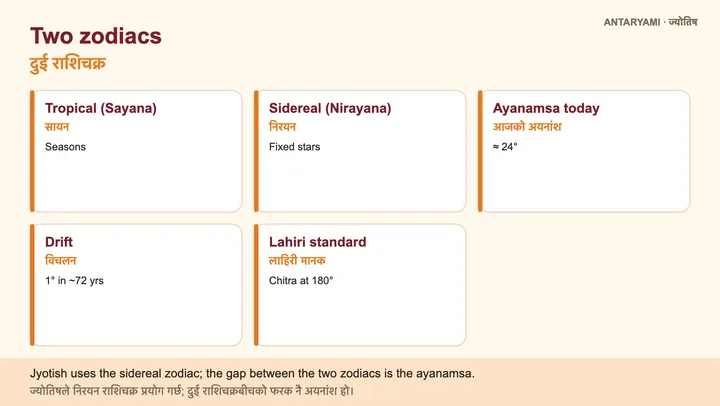
Both systems use the same twelve signs, Aries to Pisces, but they start counting from different points in the sky. Western astrology fixes the start of Aries to the seasons: the March equinox. Vedic astrology fixes it to the stars. Over the centuries those two starting points have drifted apart, and today they are a little over 24 degrees apart.
A sign is 30 degrees wide, so a 24-degree shift moves most placements back by one sign. If your Western sun sign is Leo, your Vedic sun sign is most likely Karka (Cancer). Neither is wrong: they are two rulers laid down from different marks.
Sidereal vs tropical zodiac, and the ayanamsa
The Earth wobbles slowly on its axis, like a spinning top. Because of this precession, the point where the Sun stands at the March equinox slides backwards against the stars by about one degree every 72 years. The tropical (sayana) zodiac moves with that point; the sidereal (nirayana) zodiac stays with the stars.
The distance between the two is called the ayanamsa. Jyotishis in Nepal and India mostly use the Lahiri (Chitrapaksha) ayanamsa, which puts it at a little over 24 degrees today. Antaryami uses Lahiri. In the lesson below, Jyotish Prakash Basistha explains the two zodiacs and the ayanamsa with diagrams.
What is my Vedic sign? Three answers
In the West, “your sign” almost always means your sun sign. In Jyotish there are three signs that matter, and when a Nepali or Indian family asks your rashi, they mean the second one.
- Sun sign (Surya rashi): where the Sun was at your birth, in the sidereal zodiac. It shows your soul, father and authority, but it is not the sign Jyotish leads with.
- Moon sign (Janma Rashi): where the Moon was at your birth. This is “your rashi” in Nepal and India, the sign your rashifal and your name letters follow.
- Ascendant (Lagna): the sign rising on the eastern horizon at the minute you were born. It sets the houses of the whole chart and needs an accurate birth time.
Vedic sun sign dates
In Jyotish the Sun enters each sign at a sankranti, and these fall around the middle of each Western month rather than near the 20th. These are the usual dates; any year they can move by a day, so if you were born on a changeover day, check your chart.
- Mesha (Aries)About 14 April to 14 May
- Vrishabha (Taurus)About 15 May to 14 June
- Mithuna (Gemini)About 15 June to 16 July
- Karka (Cancer)About 17 July to 16 August
- Simha (Leo)About 17 August to 16 September
- Kanya (Virgo)About 17 September to 16 October
- Tula (Libra)About 17 October to 15 November
- Vrishchika (Scorpio)About 16 November to 15 December
- Dhanu (Sagittarius)About 16 December to 13 January
- Makara (Capricorn)About 14 January to 12 February
- Kumbha (Aquarius)About 13 February to 13 March
- Meena (Pisces)About 14 March to 13 April
Seven other differences between Vedic and Western astrology
The zodiac is the difference people notice first, but the two traditions differ in how they read a chart too.
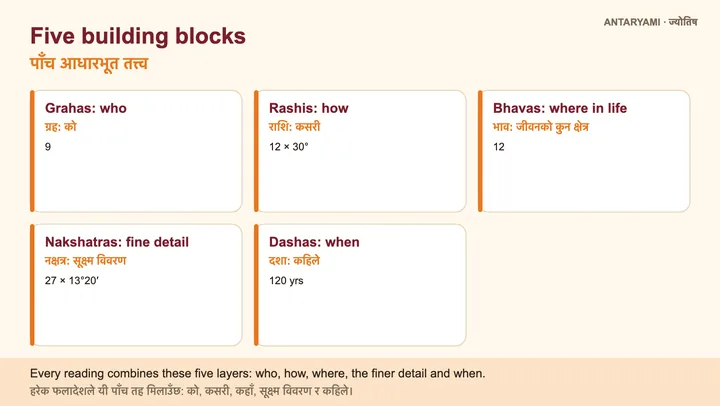
- The lead signVedic leads with the Lagna and the Moon; Western with the Sun.
- NakshatrasJyotish divides the sky into 27 lunar mansions as well as 12 signs. Your birth nakshatra drives your dasha, your name letters and marriage matching. Western astrology has no equivalent in common use.
- TimingJyotish times life events with dashas (planetary periods, Vimshottari being the best known) and gochar. Western astrology uses transits and progressions.
- The planetsJyotish uses the seven visible planets plus Rahu and Ketu, the Moon’s nodes. Western astrology adds Uranus, Neptune and Pluto.
- Divisional chartsJyotish reads vargas such as the Navamsa (D9) for marriage and inner strength, and the Dashamsa (D10) for career.
- The chartA Vedic chart is square, in the North Indian diamond (used in Nepal) or the South Indian grid. A Western chart is a wheel.
- PracticeJyotish comes with matching (Ashtakoota), muhurta (choosing auspicious times) and remedies such as mantra, charity and meditation. Western astrology is mostly about character and psychology.
How to read a Vedic birth chart →Kundali matching guide →Wedding muhurta →
Which is more accurate?
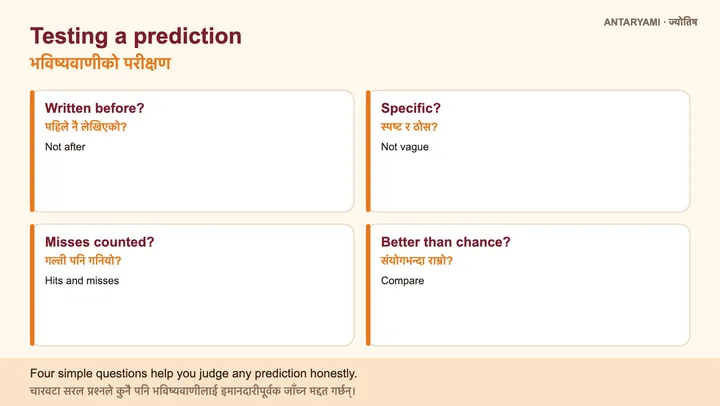
This is the question everyone asks, and the honest answer is that they are built for different jobs. Western astrology today is mostly a language for personality and inner life. Jyotish was built as a tool for timing: when a period of growth, difficulty, marriage or travel is likely to open, through the dashas. People who come to Jyotish often say it is the timing that convinces them.
Whichever you use, use one system at a time. Mixing a Western sun sign with a Vedic dasha, or a tropical chart with Vedic rules, gives answers that belong to neither. And neither system decides your life. As Jyotish Prakash Basistha puts it, planets do not make your future; you do.
Cast your free Vedic chart →Check your chart against past events →
Why learn Jyotish in a community
Switching systems is easier with company. On your own, a new sign, 27 nakshatras and nine dashas can feel like starting again from nothing. In a group you see the same ideas applied to real charts, hear the questions you had not thought to ask, and find out quickly which parts of your old Western reading still carry over.
The Antaryami Official community is built for this. Jyotish Prakash Basistha teaches the Introduction to Jyotish course there (the lesson above is one of its 105), posts upcoming transits, and answers members’ questions in Nepali and English. It is free to join.
Jyotish and meditation have always gone together. If you want a calm daily practice alongside your study, Meditation for Beginners starts from zero, and the Soham guided meditations on YouTube are free.
Join the Antaryami Official community ↗Introduction to Jyotish course ↗Prakash Bhattarai Community (free) ↗Meditation for Beginners community ↗meditationforbeginners.com ↗Soham guided meditations on YouTube ↗
See your own Vedic chart
The clearest way to see the difference is to look at your own chart. Antaryami calculates it with the sidereal zodiac, Lahiri ayanamsa and Drik Ganita, shows your Lagna, Moon sign, nakshatra and dashas in English or Nepali, and lets you ask Antaryami AI about any part of it. It is free, needs no account, and is also in the Antaryami app on Android, with iPhone in public beta.
Cast your free Kundali →Ask Antaryami AI →Talk to a Jyotishi →Get the Antaryami app →
Questions people ask
Why is my Vedic sign different from my Western sign?
Vedic astrology measures the signs against the stars (sidereal); Western astrology measures them from the March equinox (tropical). The two are now a little over 24 degrees apart, so most placements move back by one sign.
Does everyone’s sign change in Vedic astrology?
Not everyone’s. If a planet sat in the last six degrees or so of a sign in the tropical chart, it stays in the same sign in the Vedic chart. For most people, most planets move back one sign.
Which sign should I use for my rashifal?
For a Nepali or Indian rashifal, your Vedic Moon sign (Janma Rashi). For a Western horoscope, your tropical sun sign. Do not mix the two.
What is the ayanamsa?
The angle between the tropical and sidereal zodiacs. It grows by about one degree every 72 years. The Lahiri ayanamsa, used across Nepal and India and by Antaryami, is a little over 24 degrees today.
Is Vedic astrology the same as Jyotish?
Yes. Jyotish is the Sanskrit name; “Vedic astrology”, “Hindu astrology” and “Indian astrology” are English names for the same tradition, practised in Nepal and India.
Can I use both systems?
You can study both, but read each chart by its own rules. A Western chart read with Vedic dashas, or the reverse, gives muddled answers.