
Nepali patro 2083: how to read the Nepali calendar
Every Nepali home has a patro on the wall or on the phone. It tells you more than the date: the tithi, the festivals, the public holidays, and, if you know how to read it, when the day is good for a new beginning.
This guide, by Jyotish Prakash Basistha, explains how the Bikram Sambat calendar works, what the panchang on each day means, and why Nepalis in Australia, the US or the UK sometimes celebrate a festival on a different day from Nepal.
What is the Nepali patro?
The Nepali patro is the Bikram Sambat (BS) calendar, Nepal’s official calendar, printed together with the panchang: the tithi, nakshatra and other details of each day that Jyotish uses for festivals and auspicious times.
Bikram Sambat runs about 56 years and 8 months ahead of the Gregorian calendar. The new year starts on 1 Baishakh, in mid-April. BS 2083 began on 14 April 2026 and runs until 13 April 2027; BS 2084 begins on 14 April 2027.
The twelve Nepali months
Nepali months are solar: each one starts when the Sun enters a new sign (a sankranti). The Sun moves at slightly different speeds through the year, so months run from 29 to 32 days, and their lengths change from year to year. Swipe through the months with their lengths in 2083 and the Gregorian months they roughly cover.
- 1. Baishakh (बैशाख)Mid-April to mid-May
- 2. Jestha (जेठ)Mid-May to mid-June
- 3. Ashadh (असार)Mid-June to mid-July
- 4. Shrawan (साउन)Mid-July to mid-August
- 5. Bhadra (भदौ)Mid-August to mid-September
- 6. Ashoj (असोज)Mid-September to mid-October
- 7. Kartik (कात्तिक)Mid-October to mid-November
- 8. Mangsir (मंसिर)Mid-November to mid-December
- 9. Poush (पुस)Mid-December to mid-January
- 10. Magh (माघ)Mid-January to mid-February
- 11. Falgun (फागुन)Mid-February to mid-March
- 12. Chaitra (चैत)Mid-March to mid-April
Tithi: why festival dates move every year
While the months follow the Sun, most festivals follow the Moon. A tithi is a lunar day: the time it takes the Moon to move 12 degrees ahead of the Sun. There are 30 tithis in a lunar month, fifteen in the waxing half (shukla paksha) ending at Purnima, and fifteen in the waning half (krishna paksha) ending at Aunsi.
Dashain, Tihar, Teej and Chhath are set by tithi, so they land on a different BS and Gregorian date each year. Festivals tied to the Sun, such as Maghe Sankranti on 1 Magh, stay on the same Nepali date. A tithi does not match a calendar day either: it can begin in the afternoon, and now and then one is skipped or repeated.
The panchang: five things each day
Panchang means “five limbs”. Under each date, a full patro gives the five elements a Jyotishi reads to judge a day:
This arithmetic of the sky is Siddhanta, one of the three branches of Jyotish. In the lesson at the end of this section, Jyotish Prakash Basistha explains what Jyotish is and how its three branches fit together.
- TithiThe lunar day, from Pratipada to Purnima or Aunsi.
- VaarThe weekday, each ruled by a planet (Aaitabar by the Sun, Sombar by the Moon, and so on).
- NakshatraWhich of the 27 lunar mansions the Moon is passing through.
- YogaOne of 27 combinations of the Sun’s and Moon’s positions.
- KaranaHalf a tithi, eleven in all.
Sait, Rahu Kaal and good times in the day
A sait (muhurta) is a window of time chosen for an important beginning: a wedding, a griha pravesh, a journey, a puja. A Jyotishi builds it from the panchang, then checks it against the charts of the people involved. A printed patro can tell you which days are traditionally favourable; a sait for your own event needs your own details.
Within each day, the panchang also marks short periods. Rahu Kaal, about an hour and a half that falls at a different time each weekday, is traditionally avoided for new beginnings. Abhijit muhurta, around local midday, is widely treated as auspicious. All of these depend on your local sunrise and sunset, so they are different in Sydney and in Kathmandu.
Rahu Kaal and Abhijit for today →How a wedding muhurta is chosen →Griha pravesh and property →
Using the Nepali patro outside Nepal
A printed patro is calculated for Kathmandu. For dates that is usually fine, but tithis and sait are tied to the Sun and Moon as seen from where you are. Tradition takes the tithi in force at sunrise (udaya tithi) as the tithi of the day, and sunrise in Sydney, Dallas or London is hours away from Kathmandu’s. So a festival can fall a day earlier or later abroad, and a Laxmi Puja or Bhai Tika sait must be worked out for your own city, not copied across in clock time.
That is why Antaryami calculates festival sait city by city, following the Nepal Panchang Nirnayak Samiti’s method, and why the panchang page uses your own location. The Patro itself shows Kathmandu’s calendar, with Nepal’s or India’s festivals and public holidays.
Tihar 2026, 45 cities →Panchang for your city →Nepali Jyotish worldwide →
Why keep the patro with a community
Far from home, the patro is easy to lose touch with. Back in Nepal, the festival comes to you: neighbours, temples and the radio remind you that Aunsi is tomorrow or that the sankranti falls this week. Abroad you have to go looking. A community brings that rhythm back, with someone to ask which day Bhai Tika falls in your city and others who keep the same days.
In the Antaryami Official community, Jyotish Prakash Basistha posts each sankranti, retrograde and sign change ahead of time with what it means, shares festival sait, and teaches the Introduction to Jyotish course, which the lesson above comes from. It is in Nepali and English, and free to join.
Festival days are also days for stillness. If you would like a short daily practice, Meditation for Beginners starts from zero, and the Soham guided meditations on YouTube are free.
Join the Antaryami Official community ↗Introduction to Jyotish course ↗Prakash Bhattarai Community (free) ↗Meditation for Beginners community ↗meditationforbeginners.com ↗Soham guided meditations on YouTube ↗
The Antaryami Nepali patro, free
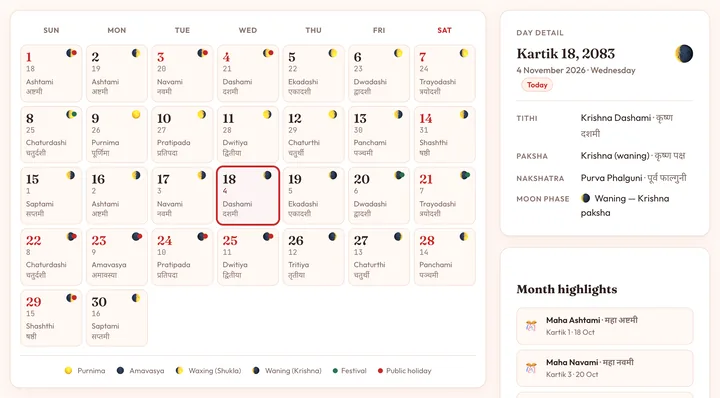
Antaryami’s patro shows each month in Bikram Sambat with the Gregorian dates alongside, festivals for Nepal or India, public holidays, and the tithi, paksha, nakshatra and Moon phase of any day you tap. The panchang gives the same details, with Rahu Kaal and Abhijit, for your own location, and the date converter turns BS dates into AD and back. All free, in Nepali and English, on the website and in the Antaryami app on Android, with iPhone in public beta.
Open the Nepali patro →BS to AD date converter →Daily rashifal guide →Get the Antaryami app →Follow on Facebook ↗
Questions people ask
What year is it in the Nepali calendar?
BS 2083, from 14 April 2026 to 13 April 2027. BS 2084 begins on 1 Baishakh, 14 April 2027.
How do I convert a Nepali date to an English date?
BS is roughly 56 years and 8 months ahead of AD, but month lengths change every year, so use a converter rather than arithmetic. Antaryami’s date converter does it both ways.
Why are Nepali months different lengths?
Each month runs from one solar sankranti to the next, and the Sun moves faster in some parts of the year than others. Months range from 29 to 32 days and vary from year to year.
Why does a festival fall on a different day in Australia or the US?
Festivals follow the tithi at local sunrise. Sunrise in Sydney or New York happens at a different moment from Kathmandu’s, so the tithi of the day can differ, and the festival can move by a day. Sait times must be calculated for your own city.
What is a tithi?
A lunar day: the time the Moon takes to gain 12 degrees on the Sun. A lunar month has 30 tithis, fifteen waxing up to Purnima and fifteen waning down to Aunsi.
Is the Nepali patro the same as the Indian panchang?
They share the same panchang (tithi, nakshatra, yoga, karana) and the Vikram era. Nepal’s Bikram Sambat starts the year on 1 Baishakh with solar months, while many Indian calendars use lunar months and start the year at a different point. Some festival dates also differ.